

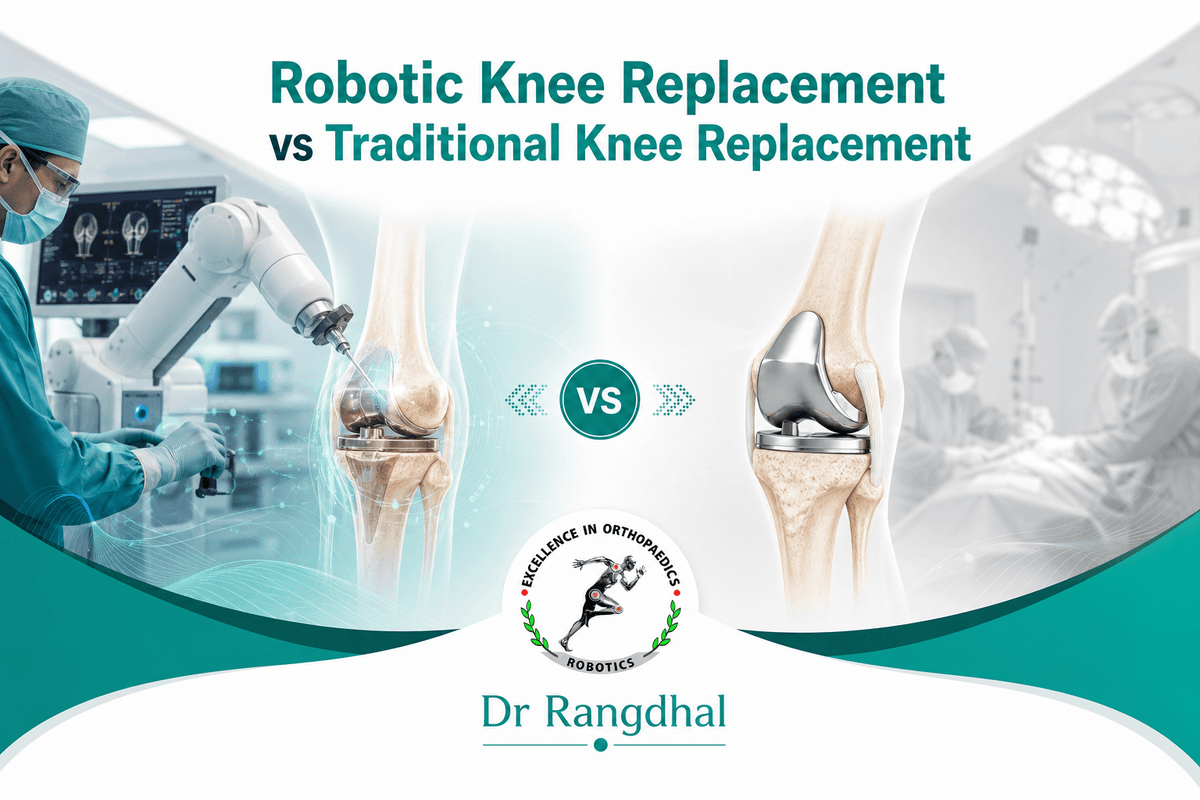
Robotic Knee Replacement vs Traditional Knee Replacement: What Patients in Nanded Need to Know
You've Been Living With Knee Pain — But Is Surgery Your Only Option? And If So, Which Kind?
If you're someone in Nanded who wakes up every morning dreading the first few steps to the bathroom, who can't walk to the market without your knee throbbing, or who has been quietly skipping family functions because standing for long is simply too painful — you are far from alone.
Around 23.46 million individuals in India had osteoarthritis in 1990; this number increased to over 62 million by 2019 — and it continues to rise. The prevalence of knee osteoarthritis in India is estimated at 22–39%, making it one of the most widespread causes of disability in the country.
The rising prevalence of OA will create significant challenges for public health in India, leading to increased disability and reduced quality of life — and limited access to specialised orthopedic care in smaller towns often delays diagnosis until the disease has progressed to advanced stages.
When medication, physiotherapy, and lifestyle changes stop working, knee replacement surgery becomes the next serious conversation. But patients in Nanded are increasingly asking: Should I choose robotic knee replacement or traditional knee replacement? Here's what you need to know — with clarity, not confusion.
The Direct Answer: Robotic Knee Replacement Offers Greater Precision and Better Long-Term Outcomes
Robotic knee replacement surgery offers several advantages over traditional knee replacement surgery, including more precise implant placement, reduced risk of complications, and better long-term outcomes.
Robotic knee replacement is a modern surgical procedure that uses robotic technology to achieve unprecedented accuracy. Unlike traditional knee replacement, which relies heavily on the surgeon's skill and experience alone, robotic knee replacement involves a robotic arm controlled by the surgeon. This technology provides real-time feedback and a three-dimensional model of the patient's knee, which helps in planning and executing the surgery precisely.
Traditional knee replacement surgeries are effective but often involve challenges such as alignment inaccuracies and a higher risk of human error, potentially leading to less-than-optimal outcomes.
In straightforward terms:
- Traditional Knee Replacement uses manual surgical instruments and relies on the surgeon's hand-eye judgement for bone cuts and implant placement.
- Robotic Knee Replacement uses computer-guided, pre-mapped 3D imaging of your specific knee anatomy, allowing the surgeon to execute bone cuts and implant positioning to sub-millimetre accuracy — with the robotic arm as a precision tool.
A computer-guided robotic arm ensures sub-millimetre accuracy in bone cutting and implant placement, reduces human error in implant alignment — the most common cause of long-term failure — and causes less soft tissue damage during surgery, resulting in faster recovery and reduced post-operative pain.
Both procedures are valid. But if you are looking for faster recovery, better joint longevity, and fewer revision surgeries, the evidence increasingly favours the robotic approach.
How Dr. Rangdhal Brings Robotic Knee Replacement to Nanded
For patients across Nanded and the surrounding Marathwada region, travelling to Pune or Hyderabad for a high-precision robotic knee replacement has been an unfortunate reality — until now.
Dr. Rangdhal is one of the very few robotic surgeons practicing in Nanded, bringing this advanced surgical technology directly to patients in the region. His practice ensures that people in Nanded no longer have to compromise on the quality of care they receive.
Here is what the surgical journey looks like at Dr. Rangdhal's clinic:
Pre-Surgical 3D Planning — Special software and sensors create a 3D image of the knee before surgery, allowing doctors to plan the surgery in detail and place the implant directly where it's needed.
Robotic-Assisted Surgery — A small incision is made to access the knee joint. The robotic system then guides the surgeon in removing the damaged bone and cartilage with high precision. Using the preoperative plan, the system helps accurately position the implant.
Faster Recovery and Discharge — Modern techniques such as robotic knee replacement allow patients to leave the hospital within 1 to 4 days and resume most activities within 4 to 6 weeks.
Supervised Rehabilitation — Week 1 involves supervised physiotherapy and pain management in hospital. Weeks 2–4 focus on basic movements at home with swelling reduction and light walking. Weeks 5–8 bring improved strength and mobility, with walking aids slowly phased out. By weeks 9–12, patients achieve full weight-bearing and independent mobility.
Dr. Rangdhal's patient-first approach means that residents of Nanded — whether from the city centre, Vazirabad, Shivajinagar, or rural areas of Nanded district — receive international-standard robotic orthopaedic care right in their own city.
The Evidence: Why Robotic Knee Replacement Numbers Speak for Themselves
The data behind robotic knee replacement is compelling and growing year by year.
Through the use of robotic-assisted orthopaedic surgeries, the success rate is close to 98%.
The robotic knee replacement success rate is 93–97% — meaningfully higher than traditional surgery, particularly for younger and more active patients with long-term performance expectations.
The success rate of knee replacement surgery in India is over 95%, comparable to global standards. With proper rehabilitation and quality implants, many patients enjoy pain-free mobility for 15–20 years.
A recent meta-analysis found that robotic TKA patients experienced shorter hospital stays, higher rates of home discharge, and fewer readmissions at 90 days compared to manual TKA.
5 lakh people undergo total knee replacement in India every year — 2.5 times the number performed annually just five years ago.
Studies report that patients undergoing robotic-assisted knee replacement experience shorter hospital stays and earlier milestones in walking and joint movement compared to conventional techniques. Because soft tissues are preserved more precisely, swelling and stiffness may subside earlier, allowing rehabilitation to start sooner.
While the procedure may be slightly more expensive than traditional methods, the higher accuracy, fewer complications, and quicker return to mobility make it a cost-effective option in the long run.
While advanced technology plays a major role, the skill, experience, and decision-making of the surgeon remain the most important factors in achieving successful outcomes in robotic knee replacement. This is precisely why having a trained and experienced robotic surgeon like Dr. Rangdhal available in Nanded matters so much.
Frequently Asked Questions (FAQs)
Q1. What is the main difference between robotic and traditional knee replacement?
The robotic system allows for more accurate bone cuts, precise placement of components, and optimal alignment of the knee joint. In conventional knee surgery, bone resection techniques are associated with poor reproducibility — and inaccurate implant positioning or gap balancing may lead to reduced patient recovery, prolonged rehabilitation, and less satisfactory outcomes. In short, robotic surgery reduces human error and is customised to your knee's exact anatomy.
Q2. Is the recovery from robotic knee replacement really faster than traditional surgery?
Yes, significantly. Patients experience less pain, better overall function, and faster recovery time compared to those who undergo traditional surgery. After surgery, you may stay in the hospital for one to three days on average. Many patients can move around with the help of a cane or walker within two weeks. Your body needs less time to heal because the technology improves surgical accuracy and reduces tissue damage.
Q3. Who is the right candidate for robotic knee replacement surgery?
The decision is usually based on the patient's age, lifestyle, diet, and the severity of the joint damage. Patients suffering from osteoarthritis are also good candidates for robotic knee surgery, depending on whether their condition hasn't progressed too extensively. In some patients, the swelling and stiffness accompanied by pain become unbearable and restrict regular movement and daily activities. Usually, if prescription medication and physical therapy no longer alleviate the pain, the patient might be ready for surgery.
Q4. Is robotic knee replacement surgery available in Nanded, or do I need to travel to Pune or Hyderabad?
You no longer need to travel out of Nanded for this procedure. Dr. Rangdhal is one of the very few qualified robotic surgeons in Nanded, offering advanced robotic knee replacement surgery to patients across Nanded city and the wider Nanded district — including those from Ardhapur, Mudkhed, Degloor, Biloli, and Hadgaon. This means patients in Marathwada can now access precision robotic orthopaedic care close to home, without the expense and stress of travelling to a metro city.
Q5. How long do robotic knee replacement implants last, and will I need surgery again?
About 85 to 90% of TKR implants can survive for 20 to 25 years, depending on the patient's overall health and how they care for the knee. Robotic technology further reduces human error, ensuring precise placement of implants and alignment of joints — which directly improves implant longevity. Key statistics include a success rate of 95% to 98% in properly selected patients, with reduced revision surgery rates due to better implant alignment. The better the initial alignment, the longer the implant lasts — and the less likely you are to need a second surgery.
Visit Us
Visit Dr Rangdhal for trusted, compassionate care. We're here for you and your family.
Dr Rangdhal
Nanded
Phone: +91 96652 24447
Website: www.drrangdalroboticsurgeon.com
Google Maps: https://maps.app.goo.gl/gxyHDsg87t94vm6E7
Email: drsushil@drrangdalroboticsurgeon.com