

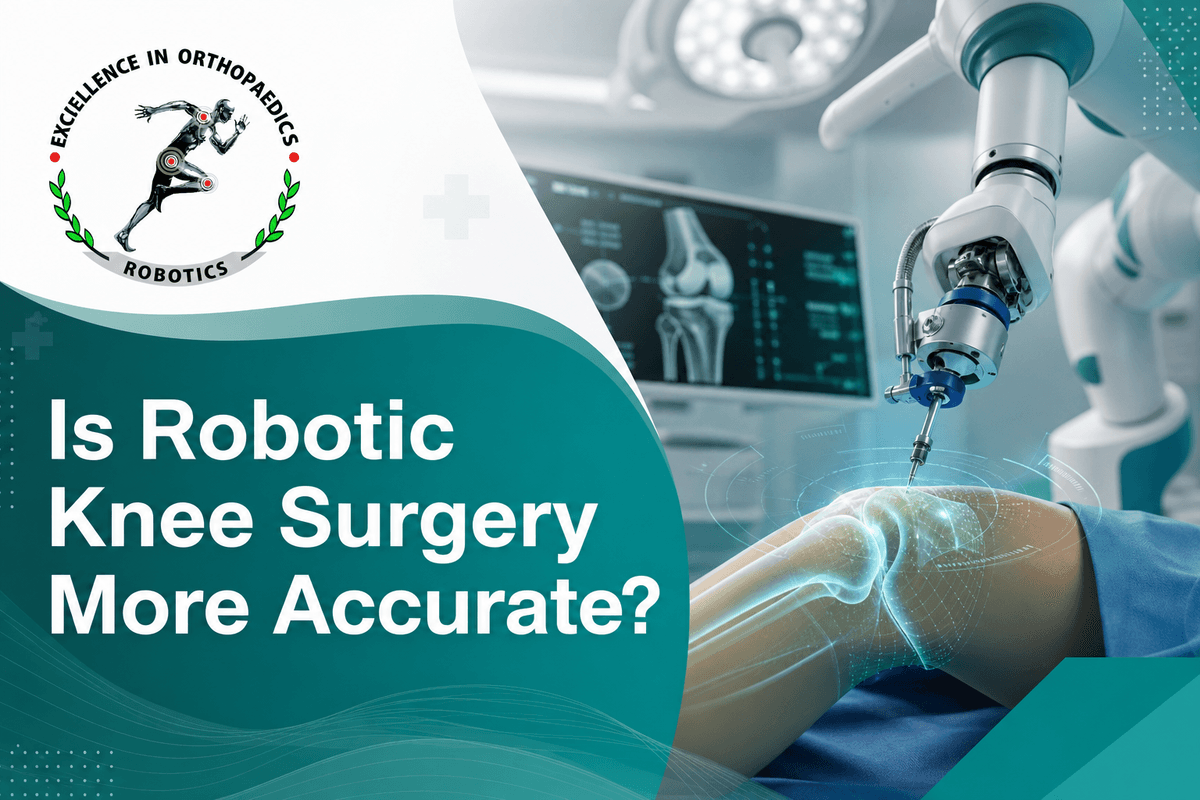
Is Robotic Knee Surgery More Accurate? What Patients in Nanded Need to Know
The Problem: Your Knee Pain Is Real — But So Is Your Fear About Surgery
You wake up every morning and the first thing you feel is your knee. The grinding. The stiffness. The sharp pain when you try to climb stairs or lower yourself into a chair. Knee arthritis is not a small inconvenience — it steals your independence, your sleep, and your ability to enjoy everyday life.
Studies reveal a high prevalence of knee osteoarthritis among over one-third of individuals aged 40 and above in rural South India. Significant predictors for the development of knee OA include diabetes, obesity, and hypertension in women — conditions that are increasingly common across Marathwada, including Nanded.
Your doctor has told you it is time for a knee replacement. And now a new question is keeping you up at night: Is robotic knee surgery actually better — or is it just more expensive?
It is a fair, intelligent question. Patients in Nanded and across the Nanded district deserve a straight, honest answer before making one of the most important health decisions of their lives. Dr. Rangdhal, a robotic surgeon serving Nanded, breaks it all down for you below.
The Answer: Yes, Robotic Knee Surgery Is Measurably More Accurate
The short answer is: robotic-assisted knee replacement is significantly more accurate than traditional manual surgery, and that accuracy translates directly into better outcomes for you.
Here is why it matters. Traditional knee arthroplasty achieves good overall outcomes, yet 15–30% of patients remain dissatisfied, often attributed in part to variability in implant positioning and soft-tissue balance. In other words, even after an operation, a large number of patients are still unhappy because the implant was not placed with enough precision.
Literature attributes dissatisfaction to issues such as component malalignment, leading to persistent pain, stiffness, or instability.
Robotic surgery eliminates most of this guesswork. During a robot-assisted knee replacement surgery, data regarding the shape of the knee and the tension of the patient's ligaments is provided to the robotic program through real-time assessment, and the surgeon plans implant positioning accordingly — and the robot then shows the surgeon where to perform the cuts to better execute the desired plan, allowing for more accuracy and personalization of implant placement.
Critically, despite the name, the robot does not operate independently — the surgeon remains in full control of the procedure throughout. Robotic technology is a tool that makes a skilled surgeon even more precise.
The Solution: Advanced Robotic Knee Surgery, Now Available in Nanded
For patients in Nanded and surrounding areas who have been told they need a knee replacement, you no longer need to travel to Pune, Hyderabad, or Mumbai to access robotic surgical precision. Dr. Rangdhal brings world-class robotic surgery expertise directly to Nanded.
Here is how the robotic process works at Dr. Rangdhal's practice:
Pre-operative 3D Planning: Before the surgery, advanced imaging such as CT scans is used to create a 3D map of your knee. This map is unique to your anatomy — no two plans are the same.
Real-Time Intraoperative Guidance: During surgery, the robotic arm guides the surgeon, ensuring precise bone preparation and implant positioning, while the robot provides real-time data to help the surgeon make ultra-accurate movements.
Personalised Implant Fit: With robotic systems, surgeons can match and position implants with millimeter precision, resulting in improved joint kinematics and durability.
Faster Recovery: Robotic technology is less invasive, which can reduce recovery times and minimize swelling and pain — and patients are typically up and moving quickly, often beginning physical therapy immediately upon returning home.
Whether you are from Nanded city, Nanded rural, or nearby talukas across the Nanded district, Dr. Rangdhal's goal is simple: to give you a knee that feels natural, lasts longer, and gets you back to life faster.
The Evidence: What the Research Actually Shows
The clinical data supporting robotic knee surgery is robust and growing. Here are the numbers that matter:
Alignment accuracy: Robotic-assisted TKA systems achieve an overall implant alignment accuracy rate of 95%.
Gap precision: In published real-world studies, 98.1% of patients had ≤ 2 mm difference in extension-flexion gaps — a level of balance simply not achievable with manual tools alone.
Improved satisfaction rates: Patient dissatisfaction following primary total knee arthroplasty with manual jig-based instruments has been reported to be as high as 30%. In contrast, results with robotic-assisted TKA are encouraging, with an overall satisfaction rate surpassing 93%, which is an improvement from historical data using manual jig-based instruments.
Better alignment, fewer revisions: Better alignment decreases the risk of long-term complications, pain, and the need for corrective procedures.
Early recovery: Patient-reported outcome scores showed improvement and exceeded pre-operative scores by just 6 weeks post-surgery, confirming that robotic-assisted knee arthroplasty provides precise control over traditionally subjective factors with excellent early post-operative outcomes.
Implant longevity: Modern knee implants typically last 15–20 years, and robotic precision may improve implant longevity by reducing abnormal wear and tear.
While advanced technology plays a major role, the skill, experience, and decision-making of the surgeon remain the most important factors in achieving successful outcomes in robotic knee replacement. That combination of cutting-edge technology and experienced surgical hands is precisely what Dr. Rangdhal offers patients in Nanded.
Frequently Asked Questions (FAQ)
1. Is robotic knee surgery safe, or is it still experimental?
Robotic knee surgery is safe and well-established — it is not experimental. Robotic surgery is a well-established technique that has undergone extensive evaluation to ensure safety and effectiveness, and it is used widely across many hospitals, having been adopted as standard practice for various surgical procedures including knee replacements. Patients in Nanded can have full confidence in the safety profile of this technology.
2. Does the robot perform the surgery on its own?
No — the robot never operates independently. All robotic systems require the orthopaedic surgeon to be in direct control of anything that touches the patient, and there is no point at which the robot autonomously performs any part of the operation. Think of the robotic system as a highly intelligent assistant that dramatically enhances the surgeon's precision.
3. How long is the recovery after robotic knee replacement compared to traditional surgery?
Recovery is generally faster with robotic surgery. Because the procedure causes less damage to the knee and surrounding soft tissue, many patients report less pain in the initial days of recovery — and a more precise fit and reduced surgical trauma mean the body spends less energy healing injured tissue and more energy integrating the new knee implant. Most patients resume normal daily activities within 6–12 weeks, depending on rehabilitation progress.
4. Will robotic knee surgery work for someone with severe or complex deformity?
Yes, robotic surgery is especially advantageous for complex cases. Robotic knee surgery is versatile and can benefit various knee conditions — it is particularly advantageous for patients who require total or partial knee replacements and are looking for a personalized solution tailored to their anatomy. The 3D pre-operative planning allows Dr. Rangdhal to account for individual bone shape, alignment, and soft tissue tension in every case.
5. Where can patients from Nanded get robotic knee surgery without travelling to a metro city?
Patients across Nanded district no longer need to travel far for robotic knee surgery. Dr. Rangdhal is a specialist robotic surgeon serving Nanded and the wider Nanded region, bringing the same level of precision and technology available in major cities directly to patients here. Robotic knee replacement in India has a success rate of over 90–95%, with advanced precision, faster recovery, and improved outcomes — and these results are now accessible to patients in Nanded without the stress, cost, or risk of long-distance medical travel.
Visit Us
Visit Dr Rangdhal for trusted, compassionate care. We're here for you and your family.
Dr Rangdhal
Nanded
Phone: +91 96652 24447
Website: www.drrangdalroboticsurgeon.com
Google Maps: https://maps.app.goo.gl/gxyHDsg87t94vm6E7
Email: drsushil@drrangdalroboticsurgeon.com