

Robotic-Assisted Knee Replacement in Nanded: What Every Knee Pain Patient Needs to Know
The Problem: Knee Pain Is Stealing Your Life — And You Deserve Better Than "Just Live With It"
You wake up every morning and the first thing you feel is that deep, grinding ache in your knee. Climbing the stairs to your second floor, squatting at the mandir, getting in and out of an autorickshaw — simple acts have become ordeals. You have been told you need a knee replacement, but the fear of major surgery, long hospital stays, and uncertain outcomes keeps you from taking that step.
You are not alone. Research shows the overall prevalence of knee osteoarthritis among elderly Indians is 35.7% — rising to 44.5% in women. Due to India's rapidly growing elderly population — expected to reach 194 million by 2031 — the burden of knee osteoarthritis will only continue to rise. In Marathwada, where physical labour is part of daily life, the toll on ageing joints is even greater.
The question patients across Nanded are now asking is not whether to get a knee replacement — it is which kind gives them the safest, fastest, and most lasting result. The answer, increasingly, is robotic-assisted knee replacement.
The Answer: What Is Robotic-Assisted Knee Replacement?
Robotic-assisted knee replacement is not science fiction — it is today's gold standard in joint surgery.
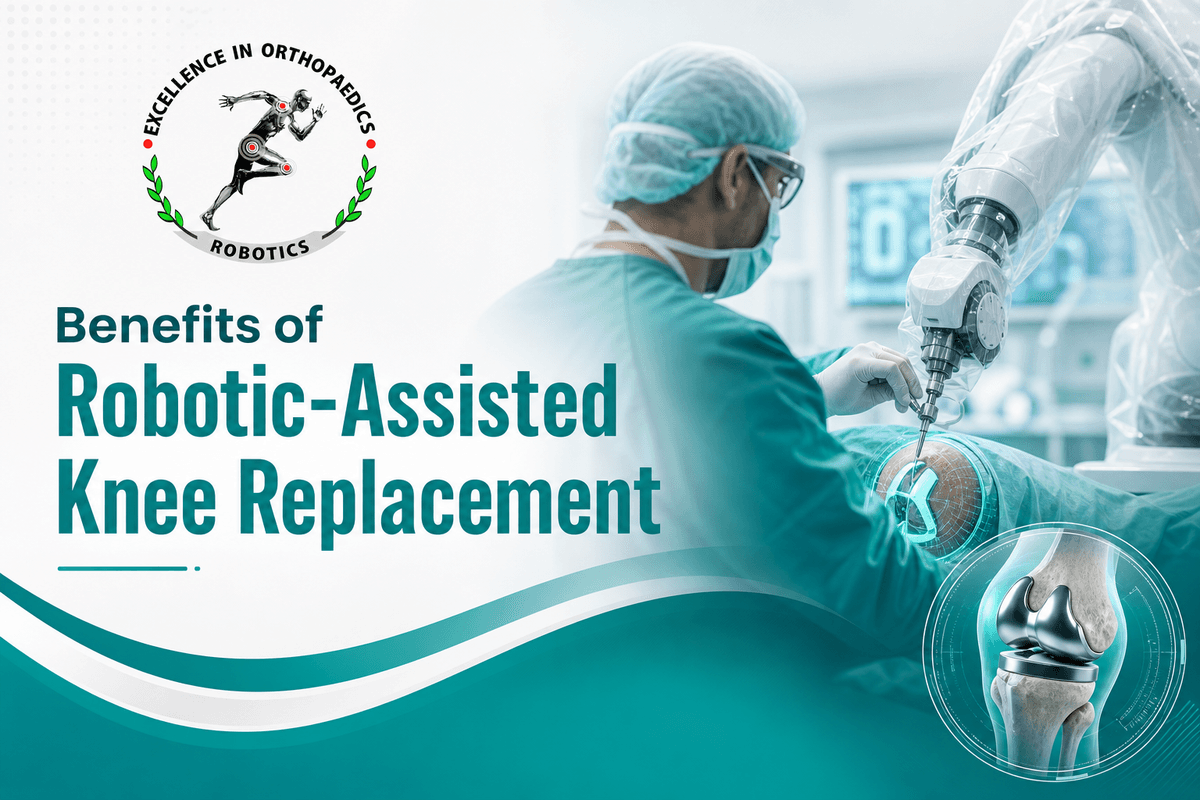
It is a minimally invasive, computer-assisted surgery where a robotic arm aids the surgeon in planning and executing the knee implant procedure with extreme precision. The system provides real-time 3D imaging, accurate anatomical mapping, and highly stable positioning for complex bone cuts and implant insertion. Preoperative CT scans or MRIs are used to create a digital 3D model of your knee.
Traditional knee replacement uses a standardised surgical approach adapted intraoperatively, whereas robotic-assisted surgery begins with a patient-specific plan built from imaging of that individual's knee — accounting for their unique bone geometry, alignment, and anatomy before a single incision is made.
What does this mean for you as a patient? It means your surgery is planned for your knee, not a generic template. Robotic-assisted knee replacement surgery allows for improved accuracy and precision, and the robotic assistant provides the surgeon with real-time data, ensuring the implant is precisely placed according to the patient's unique anatomy.
The result: a knee that moves, feels, and functions more naturally — with less damage to surrounding tissue and a quicker path back to your life.
The Solution: Advanced Robotic Knee Surgery, Now Available in Nanded
Patients from Nanded and the surrounding Marathwada region no longer need to travel to Pune, Mumbai, or Hyderabad for world-class robotic orthopaedic care. Dr. Rangdhal, one of Nanded's leading robotic surgeons, now brings this advanced surgical capability directly to the city — combining cutting-edge technology with a deep understanding of the local patient community.
Here is how the process works at Dr. Rangdhal's practice in Nanded:
Step 1 — Pre-Surgical 3D Planning: A CT scan of your knee is used to create a precise digital map of your joint. Every cut and implant angle is planned before you enter the operating theatre.
Step 2 — Robotic-Guided Surgery: During the procedure, the robotic arm provides real-time feedback, preventing the surgeon from deviating from the pre-planned boundaries. The success of a knee replacement depends heavily on how well the implant is positioned and aligned — even minor misalignments can lead to long-term issues, but robotic systems eliminate guesswork, allowing for sub-millimetric accuracy and optimal joint function.
Step 3 — Faster Recovery & Rehabilitation: Modern robotic knee replacement techniques allow patients to leave the hospital within 1 to 4 days and resume most activities within 4 to 6 weeks. Studies report that patients undergoing robotic-assisted knee replacement may experience shorter hospital stays and earlier milestones in walking and joint movement; because soft tissues are preserved more precisely, swelling and stiffness may subside earlier, allowing rehabilitation to start sooner.
Whether you are a farmer from Ardhapur, a shopkeeper from Deglur, or a retired government employee from the heart of Nanded city, Dr. Rangdhal's team designs your care plan to get you back to your daily routine as safely and quickly as possible.
The Evidence: Why the Numbers Support Choosing Robotic Surgery
The clinical data behind robotic-assisted knee replacement is compelling.
Robotic knee replacement has shown impressive success rates across leading orthopaedic centres in India, with a success rate of 95% to 98% in properly selected patients and reduced revision surgery rates due to better implant alignment.
A published study in the Journal of Knee Surgery found that 94% of patients who underwent robotic-assisted total knee replacement reported being satisfied or very satisfied with their outcome, compared to 82% in the traditional surgery group.
When it comes to complications, the advantage is equally clear. The average success rate of knee replacement surgery is about 95%; however, with robotic surgery, the complication rate drops to just 1.5%, compared to 2.6% with traditional knee replacement surgeries.
A peer-reviewed meta-analysis of randomised controlled trials confirmed that robotic knees had significantly better post-operative anatomical and mechanical restoration compared to conventional jig-based systems.
Since robotic surgery offers better implant alignment and longevity, it reduces the chances of revision surgery, making it cost-effective in the long run.
Patients benefit from quicker recoveries, less pain, and implants that function better and last longer. For residents of Nanded who want a durable, long-term solution to chronic knee pain — not a temporary fix — robotic-assisted surgery under Dr. Rangdhal's care is a decision backed by science.
Frequently Asked Questions (FAQs)
1. Is robotic knee replacement surgery safe?
Yes — it is considered safe and effective. Robotic arm-assisted total knee arthroplasty currently has some advantages over manual surgery, and with time, robot-assisted surgery is expected to emerge as the procedure of choice for total knee replacement. The robotic arm does not operate independently — it is always controlled by your surgeon, serving as a precision guide rather than an autonomous system.
2. How is robotic knee surgery different from traditional knee replacement?
The key difference is personalisation and precision. One of the meaningful distinctions of robotic-assisted surgery is the degree of individualisation it allows. Traditional knee replacement uses a standardised surgical approach adapted to the patient's anatomy intraoperatively, while robotic-assisted surgery begins with a patient-specific plan built from imaging of that individual's knee. This translates to better implant fit and more natural joint function.
3. How long does recovery take after robotic knee replacement?
Most patients are walking within days and back to daily activities within 4–6 weeks. Current literature shows a slightly faster recovery time in addition to less pain immediately after surgery; most patients are able to walk with some assistance on the day of their surgery and resume regular activities two to three months after surgery. Full recovery, including restored strength and reduced swelling, typically takes 6 to 12 months.
4. Who is a good candidate for robotic knee replacement in Nanded?
Anyone with advanced knee arthritis or joint damage that has not responded to conservative treatment. Robotic knee replacement is not for everyone — ideal candidates include older adults with osteoarthritis or younger patients with sports injuries needing durability. Patients across Nanded — including those from Kandhar, Mukhed, Biloli, and Hadgaon — are encouraged to schedule a consultation with Dr. Rangdhal to determine if they are suitable candidates based on their X-rays, medical history, and physical examination.
5. Does robotic knee replacement last longer than traditional surgery?
Evidence suggests it may — because of superior implant alignment. Precise implant alignment is associated with more natural-feeling knee mechanics and may contribute to longer-lasting results. The growing availability of global-standard robotic systems like SSI Mantra, MAKOplasty, and NAVIO has driven a surge in demand for robotic joint replacements across India, and patients in Nanded now have access to this same standard of care close to home.
All medical information in this blog is for educational purposes only. Please consult Dr. Rangdhal directly for a personalised evaluation and treatment recommendation.
Visit Us
Visit Dr Rangdhal for trusted, compassionate care. We're here for you and your family.
Dr Rangdhal
Nanded
Phone: +91 96652 24447
Website: www.drrangdalroboticsurgeon.com
Google Maps: https://maps.app.goo.gl/gxyHDsg87t94vm6E7
Email: drsushil@drrangdalroboticsurgeon.com