

Now I have all the data I need. Let me compose the full blog post.
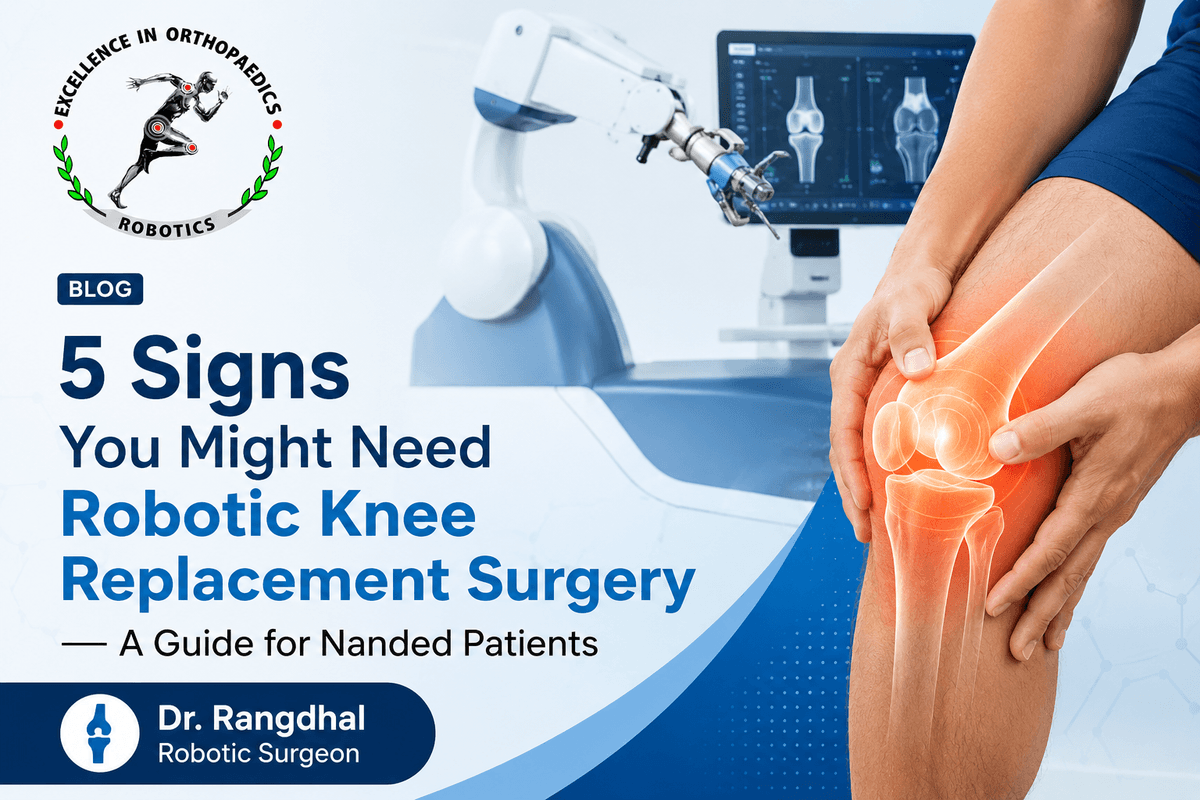
5 Signs You Might Need Robotic Knee Replacement Surgery — A Guide for Nanded Patients
Is Your Knee Pain Telling You Something More Serious?
You wake up in the morning, and before your feet even touch the floor, your knee throbs. Getting up from the floor after prayer feels like a battle. Walking to the market, climbing the steps at home, or simply squatting to use the bathroom — tasks that were once thoughtless — have become the hardest part of your day.
If this sounds familiar, you are not alone.
In India, osteoarthritis is the most frequently occurring joint disease, with a prevalence ranging from 22% to 39% of the population.
In rural and semi-urban Maharashtra — including Nanded and the surrounding Marathwada region — this burden is especially significant.
Research has reported a notably high prevalence of osteoarthritis in rural populations from Maharashtra compared to urban samples.
Many patients in Nanded quietly endure years of knee pain, assuming surgery is only for the very old, only for people in big cities, or simply not meant for them. But that delay can cost you more than you think. This guide is written specifically for patients in Nanded to help you recognise the 5 warning signs that your knee may need robotic replacement surgery — and why getting evaluated sooner rather than later makes a real difference.
What Is Robotic Knee Replacement Surgery?
Before listing the signs, it's important to understand what robotic knee replacement actually is.
Robotic knee replacement is a minimally invasive, computer-assisted surgery where a robotic arm aids the surgeon in planning and executing the knee implant procedure with extreme precision — the robot does not operate independently, but follows the expert guidance of the surgeon, who remains in full control at every step.
Unlike traditional knee replacement, robotic surgery uses a CT-based 3D model of the patient's knee to personalise the procedure.
This means the surgery is planned and customised entirely around your anatomy — not a generic template.
The implementation of surgical robotic systems has the potential to enhance the precision and accuracy of surgical outcomes, facilitate reproducibility, reduce technical variability, mitigate patient discomfort, and accelerate recovery.
The bottom line: robotic knee replacement is not experimental — it is a proven, precision-driven advancement that is now accessible to patients right here in Nanded.
5 Signs You May Need Robotic Knee Replacement Surgery
Sign 1: Persistent Pain That Medications No Longer Control
Knee replacement surgery may be used when a person can no longer control knee pain with other treatments and when the pain disrupts their life.
If you have tried physiotherapy, painkillers, cortisone injections, and lifestyle changes — and still cannot walk comfortably or sleep without pain — this is a red flag that conservative management has reached its limits.
Knee replacement surgery may be indicated if you have pain that interferes with your life on a daily basis — when simple activities like walking, shopping, and daily tasks are unbearable even though you are doing all the right treatments.
Sign 2: Pain at Rest — Even When You Are Sitting or Lying Down
Arthritis knee pain that only flares up during activity is one stage. But when pain persists at rest — when you are sitting, resting, or trying to sleep — the joint damage has progressed significantly.
It is one thing to experience knee pain when playing sports, but another when arthritis knee pain is constant — if you experience pain when standing, sitting, or just lying down for sleep, it is time to consider knee replacement surgery.
This constant, unrelenting pain is a sign of advanced cartilage loss and is a strong indicator that you should consult an orthopedic robotic surgeon in Nanded for an evaluation.
Sign 3: Severe Stiffness and Loss of Range of Motion
As the cartilage wears down, bones begin to rub together, causing pain, stiffness, and swelling that can make everyday movement difficult.
If you find it increasingly difficult to bend your knee past 90 degrees, cannot fully straighten your leg, or struggle with basic movements like climbing stairs or getting up from a chair, your joint's range of motion has been severely compromised.
As arthritis progresses, it can cause permanent limitations, such as an inability to fully extend the leg, that may persist even after surgery
— making early intervention critical.
Sign 4: Visible Knee Deformity — Bowing In or Out
Have your knees started to visibly bow outward (varus deformity) or cave inward (valgus deformity)?
Conditions such as valgus ("knock-knee") or varus ("bow leg") can lead to knee replacement.
A visibly deformed knee is a clear sign that the joint has deteriorated structurally, and this is one of the most compelling clinical indicators for surgical correction.
This deformity is a sign that your arthritis has gotten to a point that requires joint replacement surgery — the surgery may be able to restore your range of motion, realign the joints, and help you move more naturally again.
Sign 5: Knee Pain Is Disrupting Your Work, Family Life, and Independence
The overall recommendation is that when more conservative measures are no longer controlling your pain, and knee pain is significantly affecting your quality of life, knee replacement surgery would be a reasonable treatment.
For patients in Nanded — whether you are a farmer, a homemaker, a teacher, or a business owner — chronic knee pain isn't just a physical problem. It takes away your ability to work, fulfil family responsibilities, and participate in daily life.
The rising prevalence of osteoarthritis will create significant challenges for low-resource public health systems in India, and limited access to specialised orthopedic care in rural areas often delays diagnosis and treatment until the disease has progressed to advanced stages.
That delay no longer needs to happen. Nanded now has access to a robotic orthopedic surgeon.
How Dr. Rangdhal Provides the Solution in Nanded
Dr. Rangdhal is a specialised robotic surgeon serving patients across Nanded and the wider Marathwada region. As an Orthopedic Robotic Surgeon in Nanded, Dr. Rangdhal brings world-class precision technology directly to patients who would otherwise have to travel to Pune, Mumbai, or Hyderabad for this level of care.
The process begins with a detailed consultation and imaging — including X-rays and, where needed, a CT scan — to assess the degree of joint degeneration. A personalised 3D surgical plan is then created based on your knee anatomy before a single incision is made.
Robotic-assisted surgery offers greater precision in implant placement, less soft tissue damage, reduced post-operative pain, and faster recovery compared with traditional techniques — with most patients walking within 24 hours, staying in hospital for 2–3 days, returning to daily activities within 4–6 weeks, and achieving full recovery in about 4–6 months.
For Nanded patients, this means you no longer need to leave your city, burden your family with long travel, or delay a surgery that can genuinely transform your quality of life. Dr. Rangdhal's clinic brings robotic precision and compassionate orthopedic care to the heart of Nanded.
Evidence: Why Robotic Knee Replacement Is the Gold Standard
The outcomes of robotic knee replacement in India are well-documented:
-
Robotic knee replacement has shown a success rate of 95% to 98% in properly selected patients, with reduced revision surgery rates due to better implant alignment.
-
Robotic knee replacement delivers a success rate of 93–97% — meaningfully higher than traditional surgery — with computer-guided robotic arms ensuring sub-millimetre accuracy in bone cutting and implant placement, less soft tissue damage, and personalised pre-surgical 3D mapping of each patient's unique knee anatomy.
-
Robotic knee surgery delivers a success rate of 93–97% versus 90–95% for traditional surgery, with measurably higher implant precision and lower revision rates.
-
According to the American Academy of Orthopaedic Surgeons, more than 90% of total knee replacement implants are still functioning well 15 years after surgery, and many last 20 years or longer.
-
More than 2.5 lakh people undergo total knee replacement in India every year — 2.5 times the number of such procedures conducted annually about five years ago.
The technology is proven. The outcomes are strong. And now, patients in Nanded have direct access to a surgeon trained to deliver these results.
Frequently Asked Questions (FAQ)
1. How do I know if I am a candidate for robotic knee replacement surgery in Nanded?
Knee replacement surgery is generally recommended in more advanced stage 3 or stage 4 osteoarthritis of the knee.
If you have persistent knee pain, stiffness, visible deformity, or limited mobility that no longer responds to medications, physiotherapy, or injections, you are likely a candidate. A consultation with Dr. Rangdhal, the orthopedic robotic surgeon in Nanded, will include an X-ray assessment and clinical examination to confirm candidacy.
2. Is robotic knee replacement surgery safe for elderly patients in Nanded?
Yes. Robotic knee replacement is performed on patients across a wide age range.
Robotic-assisted knee surgery provides precise placement and alignment of knee implants, reduces tissue damage and blood loss, speeds up recovery, shortens hospital stays, and potentially lowers post-operative complications
— making it particularly well-suited for elderly patients who benefit from reduced surgical trauma and faster mobilisation.
3. How long will the knee implant last after robotic surgery?
Historically, knee replacements used to last around 10 to 15 years, but with progress in surgical techniques and implant technology, today's knee replacements can last for 15 to 25 years, and some even longer.
Australian data suggests that computer navigation and robotics improve implant longevity, particularly for patients under 55 years old undergoing total knee replacement.
4. What is the recovery time after robotic knee replacement surgery?
Most patients can walk with assistance within 24 hours of surgery, resume light activities in 2–3 weeks, and return to normal life within 6–12 weeks, depending on individual progress and adherence to rehabilitation protocols.
Recovery from robotic knee surgery is faster than traditional knee replacement in most cases, due to reduced soft tissue trauma and more precise surgical technique.
5. Do Nanded patients really need to travel to Mumbai or Pune for robotic knee replacement, or is it available locally?
No — you do not need to travel. Nanded patients can now access robotic knee replacement surgery right in their own city with Dr. Rangdhal, a dedicated orthopedic robotic surgeon in Nanded. Whether you are from Nanded city, Ardhapur, Hadgaon, Kinwat, Mukhed, Degloor, or the surrounding Marathwada districts, you no longer need to bear the expense, time, and stress of travelling to a metro city.
Limited access to specialised orthopedic care in rural areas often delays diagnosis and treatment until the disease has progressed to advanced stages
— Dr. Rangdhal's practice in Nanded is specifically committed to ending that delay for patients across this region.
Visit Us
Visit Dr Rangdhal for trusted, compassionate care. We're here for you and your family.
Dr Rangdhal
Nanded